
You’re standing in the sun-soaked streets of Fernandina Beach, Florida, or even the surrounding areas of Yulee, Florida, or Callahan, Florida, picturing yourself unlocking the door to your dream home.
The palm trees sway in the breeze, neighbors wave hello, and everything feels just right—until you see those extra fees in the listing: “CDD Fee” and “HOA Fee.” Suddenly, your excitement turns to confusion. What do these fees actually mean? Are they required? And how do they affect your bottom line?
If you’re feeling overwhelmed by the alphabet soup of “CDD vs HOA fees,” you’re not alone. These costs can have a real impact on your monthly budget and your long-term enjoyment of your new home. But with the right guidance, you can turn uncertainty into confidence. Let’s break down everything you need to know about CDD and HOA fees in Nassau County, FL—so you can buy smart, with total peace of mind.
Understanding CDD and HOA Fees: The Basics
What Is a CDD?
A CDD, or Community Development District, is a special-purpose governmental framework established to plan, finance, and maintain the infrastructure and amenities of a new community. Think of it as a way for developers to build roads, utilities, parks, and other shared facilities—without having to secure funding from the county.
But here’s the key: the cost of building and maintaining those improvements is passed on to homeowners through annual CDD fees, which are typically included with your property tax bill. These are not optional; if you live in a CDD community, the fees are mandatory.
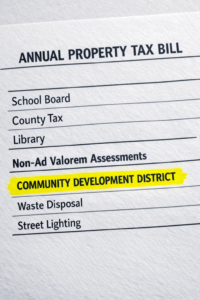
Typical CDD Charges in Nassau County, Florida
- Range: In Nassau County, CDD fees often range from $1,000 to $3,000 per year, depending on the community’s size, amenities, and development costs.
- How They’re Calculated: CDD fees are broken into two parts: (1) repayment of bonds used to fund development, and (2) ongoing operations and maintenance of communal areas (like clubhouses, pools, trails, or landscaping).
What Are HOA Fees?
An HOA (Homeowners Association) is a private organization set up by the community’s developer or residents to manage common interests, enforce community rules, and maintain shared spaces. While CDDs are a form of local government, HOAs are private associations.
HOA fees are typically paid monthly or quarterly and cover things like:
- Landscaping and maintenance of common areas
- Community pools, gyms, or clubhouses
- Security gates or neighborhood patrols
- Insurance for shared amenities
- Enforcement of community rules (architectural guidelines, lawn care, etc.)
HOA Fee Breakdown in Nassau County
- Range: HOA fees in Nassau County can be as low as $25 per month for limited amenities, or over $200 per month for luxury communities with extensive facilities.
- What’s Covered: Always review the HOA budget and covenants; some cover lawn care, pest control, or cable/internet, while others only handle basic maintenance.
CDD vs HOA Fees: What’s the Difference?
The biggest difference between CDD and HOA fees is who manages them and what they pay for:
| CDD Fees | HOA Fees | |
|---|---|---|
| Who Collects | Governmental entity (the CDD board) | Private association (the HOA board) |
| Purpose | Infrastructure, amenities, debt repayment | Amenity upkeep, community rules |
| How Paid | Annually, with your property taxes | Monthly or quarterly, separate bill |
| Mandatory? | Yes, if property is in a CDD | Yes, if property is in an HOA |
| How Long? | Bond portion may expire (20–30 years); O&M continues | Ongoing, as long as HOA exists |
Why do homes have CDD fees? CDDs allow communities to be built with top-tier amenities—parks, trails, clubhouses, pools—without requiring all the costs up front. Instead, the expense is paid over time by those who benefit from the improved infrastructure.
Are CDD Fees Mandatory? (And What If You Don’t Use the Amenities?)
Yes—if you purchase a home in a CDD community in Nassau County, Florida, you must pay the CDD fees. Even if you never use the pool or clubhouse, the charges still apply. They’re tied to the property, not the homeowner. This is one of the most important things to factor into your budget, both for your monthly expenses and for future resale considerations.
How to Decode CDD and HOA Fees in Nassau County, FL
1. Ask for a Fee Breakdown Upfront
Before you make an offer, request a clear breakdown:
- What are the annual CDD fees? (These can be found on the property tax bill and also through the company that manages the HOA for the community.)
- What portion is repayment of development bonds, and what portion is for operations/maintenance?
- What are the monthly or quarterly HOA dues, and what do they cover?
Some new communities in the Fernandina Beach, Yulee, or Callahan area may advertise “low HOA fees”—but the CDD may add a significant cost. Get the full picture!
2. Review the Community’s Amenities Carefully
Do the fees align with your lifestyle? For example:
- If you love staying active, a higher fee might be worthwhile for access to a fitness center, pool, or tennis courts.
- If you travel often or prefer minimal amenities, a lower-fee community may be ideal.

3. Factor Fees Into Your Mortgage Approval
Lenders often include HOA fees in your debt-to-income calculation, affecting your purchasing power. While CDD fees are rolled into property taxes, they still impact your total housing cost. Always be transparent with your lender about these charges.
4. Understand How Fees Can Change
- CDD Fees: The bond portion may drop off after 20-30 years, but operations and maintenance fees are ongoing.
- HOA Fees: Can increase or decrease based on community needs—review the association’s financial health and meeting minutes, if available.
5. Know the Resale Implications
Homes with higher CDD or HOA fees can appeal to buyers who value resort-style amenities, but could deter buyers prioritizing low monthly costs. If you’re thinking about selling in the future, consider how these fees fit into local market norms and price the property accordingly.
Local Nassau County Expertise: What’s Typical?
As a real estate professional specializing in Nassau County—including Fernandina Beach, Yulee, and Amelia Island—I’ve seen firsthand how fees vary by neighborhood and property type:
- Single Family Homes: Newer master-planned communities (like Wildlight or Amelia Walk) often have both CDD and HOA fees. Established neighborhoods may have only HOA fees, or minimal CDD charges if the development bond is nearly paid off.
- Condominiums & Luxury Properties: Expect higher HOA fees due to shared buildings, elevators, insurance, and luxury amenities. CDDs are less common, but still present in some resort-style complexes.
- Rental & Vacation Properties: Budget CDD/HOA fees into your cash flow analysis. Some HOAs restrict short-term rentals—always verify the community’s rules before purchasing as an investment.
An expert agent can help you compare apples-to-apples, so you’re never caught off guard.
Pro Tips for Home Buyers: Navigating CDD and HOA Fees Like a Pro
- Don’t Be Shy About Asking Questions: No question is too small. Your agent, the HOA manager, or the CDD board should provide all documentation you need.
- Attend an HOA or CDD Meeting: Many associations post minutes online or allow prospective buyers to attend. You’ll get insight into community priorities—and any upcoming fee increases.
- Consult Your Agent Early: A seasoned Nassau County agent knows which neighborhoods have CDDs, what typical charges are, and how these fees affect value and resale.
- Budget for the Unexpected: Fees can rise due to unforeseen repairs or upgrades. Look for communities with a strong reserve fund and transparent financials.
Next Steps: Make Your Move with Confidence
The world of CDD and HOA fees in Nassau County, FL, doesn’t have to be a mystery. With the right knowledge—and a local expert by your side—you can find a home that fits your lifestyle and your budget. You deserve to feel excitement, not anxiety, when unlocking the door to your new home.
Ready to start your search or have questions about a specific community’s fees?
Reach out today for a personalized consultation. I’ll help you understand every fee, every amenity, and every opportunity—so your home buying journey is clear, confident, and rewarding.
Let’s find your perfect Nassau County home—no surprises, just possibilities.
Contact me now to get started!