

If you’re facing a short sale in Nassau County or Duval County right now, there’s a tax detail almost nobody is telling you: the law that used to shield short sale sellers from a surprise IRS bill quietly expired on January 1, 2026. This isn’t meant to scare you — it’s meant to make sure you walk into your short sale with your eyes open, so nothing catches you off guard next April.
The Hidden Tax Bomb in Short Sales — And Why the Old Protection Just Expired
Here’s how it usually goes. You’ve been through months of missed payments, hard conversations, maybe a hardship letter or two.
The short sale finally closes.
The bank takes less than what you owed and calls it settled. You breathe out for the first time in a year — and then, in late January, an envelope shows up from your mortgage servicer. It’s a Form 1099-C, and it says the bank “forgave” $120,000, $180,000, whatever the shortfall was. The IRS, by default, treats that forgiven amount as taxable income. The short sale that was supposed to end your financial stress can, if you’re not prepared, hand you a tax bill on money you never actually received.
Why the Short Sale Process Suddenly Has a Tax Wrinkle in 2026
For years, the answer to that surprise 1099-C was simple: the Mortgage Forgiveness Debt Relief Act. Congress passed it in 2007, let it technically expire in 2013, and then kept extending a version of it — through 2017, then 2020, then again through 2025 — almost always at the last minute. Homeowners going through the short sale process got used to being told, correctly, “don’t worry, that forgiven debt isn’t taxable if it’s on your primary home.”
That extension ran out. The exclusion for qualified principal residence indebtedness applied to debt discharged before January 1, 2026 — or discharged after that date under a written agreement you’d already signed before the deadline. If your short sale agreement was in writing before 1/1/2026, you may still be covered. If you’re starting the short sale process now, in the second half of 2026, that automatic federal protection is gone unless Congress acts again.
There is a bill sitting in Congress — H.R. 917, the Mortgage Debt Tax Forgiveness Act of 2025 — that would make this exclusion permanent. It was introduced in February 2025 and referred to the House Ways and Means Committee. It has not passed. It may pass. It may not. Planning your short sale around a bill that hasn’t become law is not a plan — it’s a hope, and your bank account shouldn’t be built on hope.
What This Means If You’re Considering a Short Sale in Florida Right Now
Here’s the part that actually matters for Nassau County and Duval County sellers: Florida has no state income tax, so you will never owe Florida state tax on forgiven mortgage debt. That part is simple and it’s good news. But federal tax law doesn’t care what state you live in, and the federal exclusion is the one that just lapsed. So for anyone weighing a short sale in Fernandina Beach, Amelia Island, or anywhere else in Nassau or Duval County, the real question isn’t “does Florida tax this” — it’s “does anything federal still protect me, now that the automatic exclusion is gone.”
The honest answer: yes, for a lot of people — but it’s no longer automatic. You have to qualify for one of the remaining exceptions, and that takes documentation, not just a signature on a settlement statement.
The Exceptions That Still Exist (Even Without the Expired Break)
Insolvency. This is the one that saves the most short sale sellers in practice. If your total debts exceeded the fair market value of everything you owned immediately before the short sale closed, you were “insolvent,” and you can exclude forgiven debt up to the amount of that insolvency. If you owed $340,000 total across everything and owned $260,000 in assets, you were $80,000 insolvent — and up to $80,000 of forgiven debt can come off your taxable income. This requires a real net worth calculation, filed on IRS Form 982, and it needs to hold up if the IRS ever asks questions.
Bankruptcy (Title 11). If the debt was discharged as part of a bankruptcy case, it’s excluded from income regardless of insolvency. This only applies if you were actually in bankruptcy — a short sale on its own doesn’t count.
Timing. If your short sale agreement was signed in writing before January 1, 2026, you may still fall under the old exclusion even if the closing happens later in 2026. This is worth confirming with a tax professional — the date on your signed agreement matters more than the date on the closing statement.
None of these are automatic. Each one requires a form, a calculation, and in most cases, a professional who does this regularly signing off on it before you file.
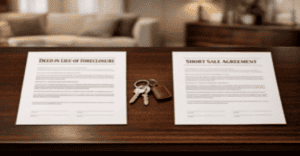
Short Sale vs. Foreclosure vs. Deed-in-Lieu: The Tax Bomb Follows You Either Way
One thing worth clearing up: this isn’t a reason to choose foreclosure over a short sale, or a deed-in-lieu over either one. A 1099-C can follow any form of debt forgiveness — foreclosure, short sale, deed-in-lieu, loan modification with principal reduction. Walking away from the short sale process doesn’t make the tax question disappear; it just trades one set of consequences for another, usually worse, set involving your credit and any deficiency judgment Florida law allows the lender to pursue. The short sale still tends to be the least damaging path for most Nassau and Duval County homeowners — it just now comes with a tax conversation that has to happen before closing, not after.
What to Do Before You Sign Anything
If you’re weighing a short sale right now, here’s what actually protects you:
- Get your insolvency numbers together before closing — a simple list of everything you own at fair market value and everything you owe, dated as close as possible to the closing date. I would also suggest your hardship letter for short sale.
- Talk to a CPA or tax attorney about your specific situation before you sign — not after the 1099-C shows up in January. This is not something to guess your way through, and it’s not something I can advise you on as your realtor — I can walk you through the short sale process itself, but the tax filing is a job for a tax professional.
- Keep every document from the short sale — the settlement statement, the written short sale agreement (and its date), correspondence with the lender — in case you need to substantiate an exclusion later.
- Don’t assume “it worked out fine for my neighbor” means it’ll work out for you. Every household’s insolvency math is different, and the rules just changed.
The Bottom Line
The short sale process itself hasn’t changed. What’s changed is that the tax safety net underneath it got a lot thinner on January 1, 2026, and most sellers don’t find out until the 1099-C lands in their mailbox. The good news is that real protections still exist, insolvency, bankruptcy, and timing all matter, but none of them are automatic anymore. If you’re in Nassau County or Duval County and thinking about a short sale, get the tax conversation started early, alongside the real estate conversation, not after the closing table.
This article is for general information only and isn’t legal or tax advice. Every household’s financial and tax situation is different — always confirm your specific numbers with a licensed CPA or tax attorney before assuming any exclusion applies to you.
If you’re facing Nassau County short sale or Duval County short sale and want to talk through your options — no pressure, completely confidential — reach out here, or call 904.601.1192.
I’m a Florida Short Sale Specialist, and I’ll walk you through what the process actually looks like so you can bring real numbers to your tax professional.
Hardship Letter Generator →
Step-by-step short sale process guide →
Free home valuation →
Sources
- IRS Publication 4681 (2025) — Canceled Debts, Foreclosures, Repossessions, and Abandonments
- H.R. 917 — Mortgage Debt Tax Forgiveness Act of 2025, Congress.gov
- The Tax Treatment of Canceled Mortgage Debt, Congressional Research Service
- Mortgage Debt Cancellation Relief Q&A, National Association of Realtors