
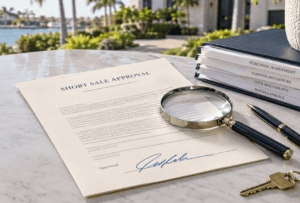
You pull the mail out of your mailbox and one envelope catches your eye. It’s from your lender.
You heart skips a beat, then starts racing like it’s in a 100 yard Olympic sprint. You open it and see: SHORT SALE APPROVAL across the top page.
You begin to breathe normal again, mixed emotions cascading all at once.
It’s almost over. What’s the letter say?
Your short sale approval letter is the most important document in the whole process. One question I hear constantly: “Once the house sells, am I done with the bank?”
Here’s the truth most sellers don’t know: the sale does not answer that. The letter does. Two sellers can close on the same day, for the same price, and one walks away owing nothing while the other can still be sued for the balance.
The difference is a few sentences on a page most people sign without reading.
What Is a Short Sale Approval Letter?
The approval letter is the bank’s written agreement to let your home sell for less than you owe. It sets the terms the bank will accept and the date they expire.
It usually arrives after weeks or months of waiting, and it often gives you only a few weeks to close. That pressure is why people skim it. Don’t.
Do You Still Owe Money After a Short Sale?
Maybe. Take a home that sells for $285,000 with $320,000 owed. That $35,000 gap is called a deficiency.
The bank agreeing to the sale does not erase the gap. It only agrees to release its lien so the buyer gets clear title. Whether the bank also gives up its claim against you is a separate question, and the letter is where it gets answered.
I covered the four ways banks handle that gap in Do You Have to Bring Cash to a Short Sale Closing? This post is about finding which one you got.
Short Sale Deficiency Judgment: What Florida Allows
Florida is not a state that protects you automatically. A lender can go to court for a deficiency judgment after a short sale unless it has given up that right.
There is one limit worth knowing. For an owner-occupied home, Florida law caps what the lender can recover at the difference between the debt and the home’s fair market value on the sale date. If the home sold at fair market value, that cap is the gap itself. It is a ceiling, not a waiver.
So the protection you need has to be in writing, in your letter.
7 Things to Check in Your Short Sale Approval Letter
1. The deficiency waiver
This is the one that matters most. Look for wording that says the bank accepts the payoff in full satisfaction of the debt and waives its right to pursue a deficiency.
Watch for the look-alike. A letter that says the bank will release its lien has only freed the property. A release of lien is not a release of debt. If the letter says the bank “reserves the right” to collect the remaining balance, or says nothing about the balance at all, treat it as no waiver.
2. Any cash or note required from you
Some lenders ask for a cash contribution at closing or a signed promissory note for part of the balance. If either is in the letter, it is a term of the deal. Negotiate it before you sign, because you can’t after.
3. The approved price and net proceeds
The price in the letter has to match your contract. Many letters also set the minimum net amount the bank must receive. If closing costs come in higher than expected, the deal can fall short of that number and stall.
4. The expiration date
Short sale approval letter expiration dates are real deadlines. Miss the closing date and you may be asking for an extension from a bank that took months to say yes the first time. Tell your buyer’s side the date the day you get it.
5. The second mortgage or other liens
If you have a second mortgage, a home equity line or an HOA lien, each one needs its own written agreement. A waiver from your first lender does nothing about what you owe the second.
6. Relocation assistance
Some loan programs pay the seller money toward moving costs. If you qualify, the amount should appear in the approval letter or the closing instructions. If it is not in writing, do not count on it.
7. How the debt will be reported
The letter may say how the account will be reported to the credit bureaus, and whether the bank will send a 1099-C for the forgiven amount. That form matters more now. See Short Sale Taxes in 2026 before you close.
The trade-off nobody mentions: a full deficiency waiver is what you want, and it is also what creates forgiven debt for tax purposes. Getting the waiver is still the right goal. Just talk to a tax professional before closing so the 1099-C is not a surprise.
Short Sale Approval Letter Sample: Wording to Look For
Every bank writes its own letter, so there is no standard form. But the sentence that matters tends to look like one of these. I wrote these examples to show the difference. They are not taken from any lender’s letter.
What you want to see:
“Upon receipt of the approved net proceeds, the lender will release its lien and accept the payment in full satisfaction of the debt. The lender waives its right to pursue any deficiency balance.”
What should stop you:
“Upon receipt of the approved net proceeds, the lender will release its lien on the property. The lender reserves the right to pursue any remaining balance owed under the note.”
Same sale. Same price. The first seller is done. The second still owes the bank.
Short Sale Approval Letter Received, Then the Buyer Changed Loans
This one catches people. The approval is written for a specific buyer, price and set of closing costs. If the buyer switches loan types after the letter arrives, say from conventional to FHA, the numbers on the settlement statement can change.
If the bank’s net drops below what the letter approved, the bank can refuse to close on those terms. Tell the negotiator about any change in the buyer’s loan the day you hear about it, and ask whether a revised approval is needed. Finding out at the closing table, with the deadline a few days away, is how approved short sales die.

How Long Can a Lender Sue After a Short Sale in Florida?
You will see “one year” all over the internet. Be careful with that number.
Florida does have a one-year deadline for deficiency claims on one-to-four family homes, but the statute ties it to a foreclosure sale or a deed in lieu. Short sales are not mentioned. According to Florida asset protection attorney Gideon Alper, two appellate courts ruled in 2017 that a short sale does not start that one-year clock, which leaves the lender the five years that apply to written contracts. The cases he cites are Bush v. Whitney Bank and Whitney Bank v. Grant.
I am a Realtor, not an attorney, and other Florida sources still say one year. So plan for the longer window. Without a waiver, assume the bank can come after the balance for up to five years, and have an attorney confirm what applies to your file.
What to Do If the Waiver Is Missing
- Do not sign yet. The letter is an offer of terms. It can be revised.
- Ask for the waiver in writing. Your agent can go back to the negotiator and request full-satisfaction language.
- Use your hardship file. A complete, documented hardship is the strongest argument for a full waiver.
- Have a Florida real estate attorney read the letter. A short review costs far less than a deficiency judgment.
If the bank will not move, you still have options to weigh, including a deed in lieu. Veterans with a VA loan follow a different process, which I cover in my VA compromise sale guide.
Quick Answers
Can the bank come after me after a short sale in Florida?
Yes, unless your approval letter waives the deficiency. Florida allows lenders to pursue the unpaid balance.
What is a deficiency waiver in a short sale?
Written language in the approval letter stating the bank accepts the sale proceeds as full satisfaction of the debt and will not pursue the remaining balance.
Is a release of lien the same as a release of debt?
No. A release of lien frees the property so it can be sold. Only a release of the debt, or a deficiency waiver, frees you.
Does the short sale buyer receive the approval letter?
The letter is addressed to the seller and usually goes through the listing agent. The buyer’s side typically gets a copy, because the buyer’s lender and the title company need its terms and deadline.
Is a pre-approval letter for a short sale the same thing?
No. A pre-approval letter is the buyer’s proof that a lender will finance them. Banks reviewing a short sale usually want to see it with the offer. The approval letter is the seller’s bank agreeing to the sale.
Can the buyer start underwriting before the approval letter arrives?
Yes, and it helps the buyer hit a short closing deadline. The risk is on the buyer’s side: an appraisal or rate lock can expire while the bank is still deciding.
Does the approval letter affect buying again?
Yes. Your next lender will ask how the balance was handled. See buying a home after a short sale.
Have an Approval Letter in Hand?
The few days between receiving that letter and signing it are when you have the most leverage. I am a veteran and a Certified Short Sale Specialist with Palm III Realty in Fernandina Beach, working with homeowners across Amelia Island, Nassau County and Duval County.
Ready to understand your specific situation? Call or text me at (904) 601-1192, or contact me today for a FREE 100% confidential analysis.
This article is general information, not legal or tax advice. I am a licensed Florida Realtor, not an attorney. Deficiency law and deadlines depend on your facts and can change. Have a Florida real estate attorney review your approval letter before you sign.
Sources: Florida Statutes section 702.06; Alper Law: Deficiency Judgments in Florida; Barnes Walker: What Realtors Need to Know About Short Sales.